

Grantee Spotlight: Dr. Corasi Ortiz
Dr. Corasi Ortiz is an assistant professor of Chemistry at Grinnell College. She earned her Ph.D. in Chemistry from Purdue University as a Sloan Scholar.
In 2023, Dr. Ortiz received an SSMN Seed Grant to support her research on synthesizing and characterizing nanozymes for biosensing and diagnostic applications. Her grant has created invaluable opportunities for her students to engage in hands-on research and present their findings at professional meetings, enhancing both their scientific knowledge and professional skills.
Read on to learn more about Dr. Ortiz's passion for teaching, her groups research, and how the SSMN Seed Grant has positively impacted her lab and path towards tenure!
1. To start, please share a little about your background (personal and/or academic) and why you chose to pursue a career in STEM.
I graduated from the University of Puerto Rico at Mayagüez with a BS in Chemistry and received my PhD in Chemistry from Purdue University. I don’t really recall what experience as a child sparked my interest in STEM. In my childhood memories, that interest has always been there and “what I wanted to be when I grew up" was a chemist or biologist.
 2. Tell us about your path to your current position and what you do in your current role.
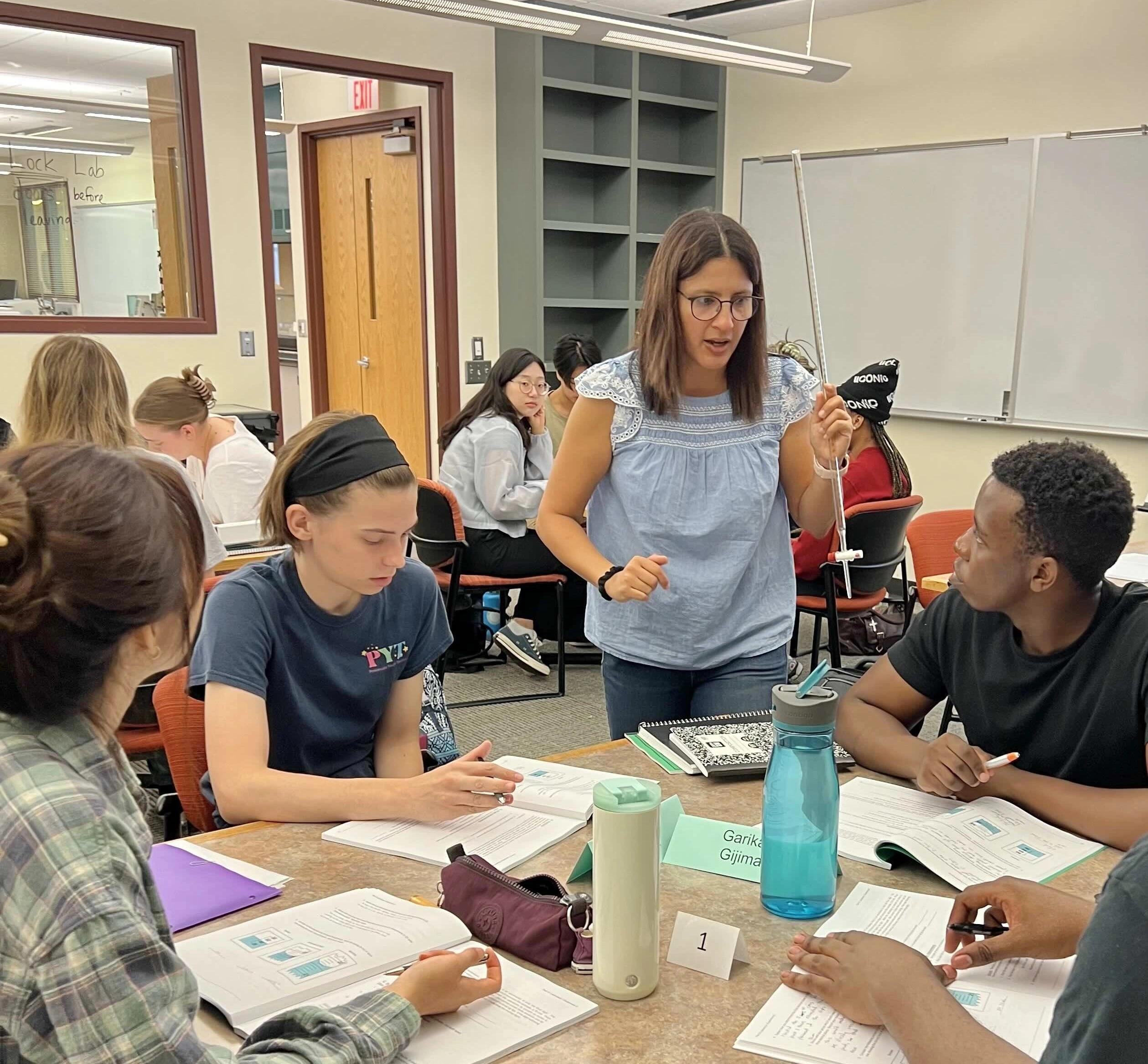
After I graduated from Purdue, my main interest has been in teaching undergraduate students. I started teaching as an adjunct at IvyTech Community College in Lafayette while I was still a graduate student, and I really enjoyed it and decided that was what I wanted to do.
Currently, I’m an Assistant Professor in Chemistry at Grinnell College, a liberal arts institution in Iowa. My main responsibilities are teaching undergraduate students in the areas of general, physical, analytical and biological chemistry. Other responsibilities include extending our teaching into the research lab and have active research projects with our undergraduate students. My research interests are in the areas of surface chemistry and applied spectroscopy, particularly Raman spectroscopy.
3. Tell us about the research or project that was supported by your SSMN grant.
Our group has been working on the synthesis and characterization of noble metal nanoparticles and monitoring their catalytic activity as enzyme mimics. Two of our current projects involve (1) gold nanoparticles as glucose oxidase mimics and (2) silver and platinum nanoparticles as peroxidase mimics. Most of the activity assays have been performed using absorption spectroscopy but work has been done to develop a Ramanbased assay as well.
4. How has receiving an SSMN grant impacted your career and/or research?
This seed grant has helped me develop this research project in my group and collect preliminary data to apply for other competitive grants. Also, as I mentioned before, mentoring undergraduate students through research is highly valued at Grinnell College. This funding has allowed me to mentor more undergraduate students and give them the opportunity to present their research work at regional and national meetings. In addition, this grant will have a positive impact on my tenure review as it serves as part of my scholarly work.
5. What advice would you share with current Sloan Scholars and fellow Sloan Scholar alumni interested in a similar career path?
My advice would be to find what they enjoy doing (teaching, research in academia or the industry, etc.) and to pursue that path. In my case, I sought opportunities early on that would allow me to explore all these different paths in my field so I could assess what made me happier. After realizing that what I enjoyed most is teaching, I’ve been lucky to join a community at Grinnell College that shares my commitment to strive for excellence in teaching. I know that anyone can find the same satisfaction I get after leaving the classroom or research lab in any line of work if they are doing what they enjoy the most.